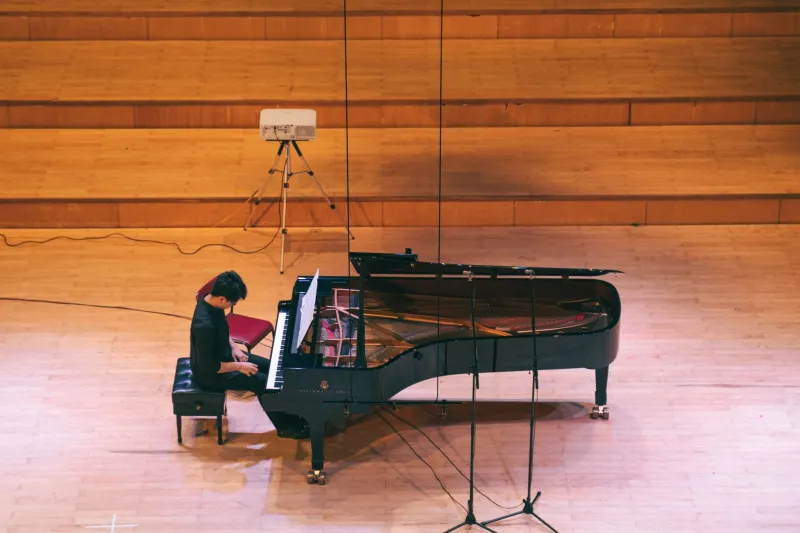
Mozart Notes Mozart, played with clarity and joy.

Mozart Notes

Mozart, played with clarity and joy.

Latest Articles

The Concerto That Listens Back: A Case for Mozart’s K. 449
Listener Guides

The Concerto That Listens Back: A Case for Mozart’s K. 449

Mozart’s Piano Concerto No. 14 in E-flat, K. 449, is too often treated as a preface to grander works. This listener’s guide argues that its chamber-like scale, conversational piano writing, and compact wit make it one of the most rewarding concertos in the repertoire—and a natural fit for American halls and modern audiences.
The Three-Minute Self-Portrait: Mozart’s Cadenzas and the Pianist Behind Them
Listener Guides

The Three-Minute Self-Portrait: Mozart’s Cadenzas and the Pianist Behind Them

In Mozart’s piano concertos, the cadenza is more than a virtuoso pause. It is a brief, revealing self-portrait in which a pianist’s temperament, taste, and willingness to take risks come into unusually sharp focus. This guide uses K. 488 and K. 466 to show listeners what to hear in those three minutes—and how Orli Shaham’s Mozart playing illuminates the choices at stake.

The Return Passage: Listening to Mozart’s Repeats With Fresh Ears
Listener Guides

The Return Passage: Listening to Mozart’s Repeats With Fresh Ears

Mozart’s repeat signs can look like formal housekeeping, but they are often the place where a performance reveals its real priorities. This guide offers a clarity-first way to hear the second pass as interpretation rather than repetition, with practical cues for sonatas, chamber music, and recordings.

Mozart’s Closing Arguments: Five Final Pages That Reward a Backward Listen
Listener Guides

Mozart’s Closing Arguments: Five Final Pages That Reward a Backward Listen

Mozart’s final bars are not mere punctuation; they are the clearest evidence of his architectural wit. This guide proposes a backward listening practice—hear the last half-minute first, then the whole movement—through five endings for piano, orchestra, chamber ensemble, and opera.

The Space Between the Notes: Mozart's Silences as a Listening Discipline
Playlists & Picks

The Space Between the Notes: Mozart's Silences as a Listening Discipline

A three-work listening session built around rests, pauses, and abrupt silences in Mozart. The essay argues that his clarity depends as much on what he withholds as on what he writes, with close attention to K. 310, K. 488, and the Requiem.

The Tiny Cell That Builds the Whole: Mozart's Art of Motive and Memory
Listener Guides

The Tiny Cell That Builds the Whole: Mozart's Art of Motive and Memory

A close listening guide to Mozart's motivic economy, from the opening of Symphony No. 40 to the Romanze of K. 466 and the theme of K. 331. The goal is not music theory but attention: hearing how a handful of notes becomes an entire argument.

Reverence Is Not the Same as Faithfulness: A Case for Curious Mozart
Listener Guides

Reverence Is Not the Same as Faithfulness: A Case for Curious Mozart

Mozart is too often played as if the primary risk were offense. An argument for curiosity over politeness, and for readings — like Orli Shaham's — that trust the score enough to let it surprise the room.

What to Play When the Guest List Isn't a Recital: A Mozart Plan for the Holidays
Playlists & Picks

What to Play When the Guest List Isn't a Recital: A Mozart Plan for the Holidays

Most holiday guests are not classical listeners, and that is not a problem to be solved — it is a room to be furnished. A movement-by-movement plan for drinks, dinner, and the long quiet afterward, with the traps worth avoiding.

The Sonata That Keeps Its Voice Down: Listening to Mozart's K. 576
Listener Guides

The Sonata That Keeps Its Voice Down: Listening to Mozart's K. 576

Mozart's last piano sonata is compact, polite on the surface, and full of small harmonic turns that reward close listening. This listener's guide explores K. 576 through Orli Shaham's priorities of clarity, joy, and unhurried detail.

A Thanksgiving Soundtrack That Leaves Room to Talk
Playlists & Picks

A Thanksgiving Soundtrack That Leaves Room to Talk

Thanksgiving music has to do two jobs at once: settle a crowded house and stay out of its way. These five Mozart works, heard through Orli Shaham's clarity-first sensibility, do both without turning into sonic wallpaper.

A Small November Ritual: Three Mozart Works for the Early Night
Playlists & Picks

A Small November Ritual: Three Mozart Works for the Early Night

When daylight saving time ends and evening arrives before dinner, Mozart can give the darkening hours a shape. This listening plan pairs three works with simple early-evening rituals, no expertise required, just a lamp, a chair, and ten to twenty minutes.

The Case for Mozart Played on the Edge: Orli Shaham and the Value of Musical Risk
Listener Guides

The Case for Mozart Played on the Edge: Orli Shaham and the Value of Musical Risk

Note-perfect Mozart can still leave a listener cold. This essay argues that clarity in Mozart is not cold accuracy but audible intention, timing, and warmth, using Orli Shaham's playing as a case study and offering three prompts for hearing the difference.

K. 332, Revisited: What a Familiar Mozart Sonata Sounds Like When You Stop Rushing It
Listener Guides

K. 332, Revisited: What a Familiar Mozart Sonata Sounds Like When You Stop Rushing It

The F major Sonata, K. 332, is the Mozart piece Orli Shaham keeps circling back to — and the one that reshaped how she thinks about clarity and joy at the keyboard. A movement-by-movement guide for anyone who thinks they already know it.

Seven Mozart Miniatures for the Ten-Minute Listener
Playlists & Picks

Seven Mozart Miniatures for the Ten-Minute Listener

Mozart turns 270 in 2026, and the anniversary does not require a four-hour commitment. Seven compact piano works — fantasies, rondos, and one very serious Adagio — that say everything in under ten minutes, with listening prompts for each.